
A Conversation about the Year of Women’s Sports
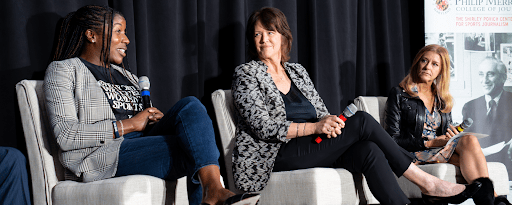
“Changing the Business of Women’s Sports” panel featuring Rosalyn Durant, Christine Brennan, and Bonnie Bernstein during the 19th Povich Symposium at Riggs Alumni Center. Courtesy of the Philip Merrill College of Journalism, Nov. 12, 2024
The University of Maryland’s Philip Merrill College of Journalism’s 19th Annual Povich Symposium, given by The Shirley Povich Center for Sports Journalism, highlighted 2024 as “The Year of Women’s Sports.”
Held at the Riggs Alumni Center, the symposium featured panels of several award-winning female authors, successful female executives, and big names in the sports broadcasting industry.
The symposium was split into two 60-minute panels, the first being “Changing the Business of Women’s Sports.” This panel featured Phil de Piccioto, founder and president of Octagon, Christine Brennan, USA Today sports columnist and CNN, ABC News, and PBS Newshour commentator, and Rosalyn Durant, ESPN’s executive vice president of programming and acquisitions. A major focus of the conversation during the panel was the recent landmark extension deal between ESPN, Disney Plus, and the WNBA and NBA that Durant helped orchestrate. All panelists agreed that women’s sports have always been marketable and profitable, but companies are starting to pick up on that now.
The second panel, “Changing the Coverage of Women’s Sports” moderated by Christine Brennan, featured Bonnie Bernstein ’92, veteran sports journalist, founder and CEO of Walk Swiftly Productions and member of Merrill College’s Board of Visitors, Mirin Fader, The Ringer staff writer and New York Times bestselling author, Melissa Ludtke, author of “Locker Room Talk: A Woman’s Struggle to Get Inside,” Ava Wallace, The Washington Post women’s sports, tennis reporter, and The Sports Moment newsletter writer, and Pam Ward, ESPN play-by-play commentator for women’s college basketball, college softball, and the WNBA.
When going around round-robin style sharing their favorite female athletes, such as Naomi Osaka and Simone Biles, Ward commented on how significant all the different names they were able to produce. “What I love about this conversation is we just named various things…and we could probably all name another one and another one and another one…now if we did this ten years ago…you might not have all known the names..well now I’m guessing all of you in the audience know exactly what we’re talking about the people we’re talking about the moments we’re talking about,” Ward said.
A major focus of this panel was the shift and drastic changes in the media landscape regarding female visibility. “Back in the ‘70s, in Sports Illustrated, you didn’t even think about suggesting a story of a woman, particularly if you were a woman,” Ward said. “The only way you saw your road to advancement was to want to cover one of the men’s sports. So that’s clearly changing.”
Another major focus was the mental health of female athletes and the battle women face to be considered “legit” in the sports stratosphere. “I used to joke that to get a woman’s pitch accepted she had to win six gold medals, survive a debilitating disease, come back, then tear her ACL, then have other drama, and now she’s amazing,” said Fader. She went on to also say “The way we cover men; the eighth man, the ninth man, he gets a story…seeing that nuance now in women’s stories it could be about their fashion, their their passing ability; the storytelling dignifies them as human beings in ways that it just didn’t before.”
While the overall theme of both panels was a hopeful and inspiring tone, delighted with the progress made in women’s sports in recent years, the panelists also acknowledged the work left to be done and the disparities still present. “I hope in 10 years I’m covering at least three female NBA coaches…women are certainly becoming much more common sights in assistant roles, on the sideline, in analytical roles, and front office roles, although it’s far less common than you might think, that’s what I hope we’re covering in 10 years, a plethora of women coaches,” said Wallace.
Additionally, Wallace said, “Adam Silver told me last year that if we don’t have our first female NBA head coach within the next five years, we’ve failed.”
During the Q&A portion after both of the panels, Christine acknowledged her recent controversy from a postgame interview with Dijonai Carrington where she asked if her poking Caitlin Clark in the eye was intentional. Several news outlets had criticized Christine’s journalistic practices and the WNBA even released a statement saying her credentials should be revoked. Sharing her opinion on the matter, Christine stressed that she only wanted to give Carrington the chance to state what had happened, “You give the athlete the chance to respond. You are a conduit.”
Brennan has a history of asking the tough questions, having interviewed Michael Phelps after his infamous DUI when he was just 19 years old and Tiger Woods about his performance enhancer use, so grilling famous athletes is nothing new to her.
A more positive portion of the Q&A section arose when a young woman asked how she, a former college basketball player who hadn’t majored in journalism or broadcasting but was interested in those fields, could break into the scene. The panelists, especially Berstein and Ludtke, offered specific and detailed advice. They even took the time to find her after the panel and gave her their contact information, exemplifying the character of the featured panelists.
The atmosphere of support, hopefulness, and positivity was resounding. These women and their legacies are beyond inspiring, and the hope for women in journalism and sports is more promising than ever.
 The Scroll